Key findings
- For articles with a DOI registered in Crossref or OpenAlex, a language model is unnecessary. A free registry query (0.828) outperforms each of the 9 models (0.61–0.69), which moreover incur costs.
- Among the models, the least expensive one achieves the highest accuracy.
gemini-3.1-flash, at USD 3.50 for 960 documents, outperforms models 14–20 times more expensive. - Differences between languages are real, but partly attributable to tooling rather than to the models. One in four Japanese PDFs has a corrupted text layer. Models that process text instead of the page image lose about 80% of their accuracy in the title and author fields on these files. Conversely, the 30-point drop in accuracy for Japanese titles is an artefact of a metric that splits text on spaces.
- Some fields are absent from the PDF content. The ISSN is printed in only 38% of articles. A model that always returns an answer produces errors in such fields.
1. Aim and scope of the study
A CRIS (Current Research Information System) is an institutional database of research output, recording the authors, titles, venues and dates of publications. A record suitable for reporting and evaluation requires a dozen or so fields: title, authors, year, DOI, journal, publisher, ISSN, pages, language, keywords and abstract. In practice these fields are transcribed manually from the PDF or copied from a registry. With several thousand publications per institution each year, this work is costly and laborious.
The research question is: can large language models take over this task, and do they perform it better than the tools already available? Most existing evaluations cover English-language articles from a few large publishers. CRIS systems in Europe and Asia, however, also process Polish university journals, Japanese learned-society bulletins and Indonesian journals published on OJS. For this reason, the corpus was designed for diversity.
2. Method
2.1. Corpus
The corpus is stratified: exactly five open-access articles were randomly sampled for each cell (year × language × OpenAlex field):
Languages: English, Spanish, Portuguese, French, German, Italian, Polish, Indonesian, Korean, Chinese, Japanese and Arabic. The Arabic cell contained too few resolvable references, so the cross-lingual conclusions concern eleven languages.
2.2. Systems compared
Nine models were compared: gemini-3.1-flash, gemini-3.1-pro, gemma-4-31b, claude-sonnet-4.6, gpt-5.4, deepseek-v3.2, qwen-3.5-max, ministral-8b and qwen-3.5-7b. All receive the same prompt and the same set of pages. The set is trimmed individually for each document: it comprises the opening and closing pages of the article, so as to include every location in which the preliminary analysis found evidence of metadata. This reduces the number of pages by 37% on average without loss of information. Of importance for the subsequent analysis is the fact that the vision models receive the PDF, whereas the three text-only models (DeepSeek and both Qwen models) receive text extracted from the same pages.
2.3. Accuracy measure
A manually verified set of gold-standard values for all 960 papers is not yet available; it will be produced at the gold-set stage (96 papers, two annotators). At the screening stage, each field is compared with two independent references: metadata from the publisher's web page (A) and from OpenAlex (B). The similarity of a single value \(v\) to a reference \(r\) depends on the field type:
The exact fields are DOI, year, ISSN, pages and language; the text fields are title, journal, publisher and abstract. \(J\) denotes the Jaccard index, \(T(\cdot)\) the token set (split on whitespace), and \(\nu\) a surname normalisation function. The functions \(T\) and \(\nu\) are of particular importance for the analysis of the Japanese results (see Section 6.3). The principal measure is availability-conditional accuracy: only those cells (document × field) for which at least one reference contains a value are counted:
An empty answer counts as 0. Accuracy so defined decomposes exactly into two factors: how often the system answers (coverage \(\varphi\)) and the accuracy of the answers given:
This decomposition is used in the analysis of whether a model should be permitted to decline to answer (see Section 3.2).
3. Aggregate results
Accuracy of the systems on 960 articles
avail-cond-acc, max(A, B); the cost is shown on hovering over a bar
| system | accuracy | coverage | acc | filled | cost (960 docs) |
|---|---|---|---|---|
| B0 registry | 0.828 | 85.6% | 0.919 | $0 |
| gemini-3.1-flash | 0.691 | 98.8% | 0.697 | $3.50 |
| gemini-3.1-pro | 0.669 | 97.6% | 0.679 | $71.98 |
| gemma-4-31b | 0.654 | 95.5% | 0.676 | $18.65 |
| claude-sonnet-4.6 | 0.650 | 81.3% | 0.766 | $71.89 |
| gpt-5.4 | 0.650 | 82.8% | 0.756 | $47.98 |
| deepseek-v3.2 | 0.639 | 80.4% | 0.761 | $2.89 |
| qwen-3.5-max | 0.629 | 84.6% | 0.723 | $13.83 |
| ministral-8b | 0.612 | 83.5% | 0.713 | $19.08 |
| B1 GROBID | 0.291 | 40.2% | 0.681 | $0 |
| B2 Docling | 0.279 | 51.7% | 0.512 | $0 |
| qwen-3.5-7b | 0.270 | 39.4% | 0.665 | $0 |
The result is unambiguous: for articles that have already been published, the most effective way to obtain metadata is not to extract them at all. When a document has a DOI registered in Crossref and OpenAlex, a single HTTP query yields an accuracy of 0.828, and in the fields that the registry contains, accuracy reaches 0.919.
This result, however, holds only conditionally. B0 is a lookup, not an extractor. For a preprint, a report, a dissertation or a newly deposited file not yet present in the registry, B0 returns zero. In such cases the models remain, and their accuracy of 0.61–0.69 is the only practicable option.
3.1. Cost and accuracy
Cost versus accuracy of LLMs
each point represents one model on the full corpus of 960 documents
gemini-3.1-flash, cost USD 3.50 for the entire corpus (about 0.4 cents per article). claude-sonnet-4.6 and gemini-3.1-pro cost about USD 72 each and achieved lower scores. In a schema-constrained task, the reasoning capabilities of the most expensive models do not translate into higher accuracy.3.2. Coverage and precision of answers
The table reveals a clear division. The Gemini and Gemma models fill 95–99% of fields. The Claude, GPT and DeepSeek models fill about 80–83% of fields, but the answers they do give are correct considerably more often (0.76 versus 0.68–0.70).
Coverage versus precision
X axis: share of fields filled; Y axis: accuracy computed over filled fields only
Which model is preferable depends on the cost of subsequent verification. For a librarian verifying records, an empty field means two seconds of work. An incorrect ISSN given without any signal of uncertainty is an error that may find its way into a report. Choosing a strategy therefore requires an answer to the question of whether the information is present in the PDF at all.
4. Presence of metadata in the document content
For each field, the frequency with which the reference value can be found in the text of the document itself was examined. The measure used is the recoverability index:
Share of articles containing the field value in their content
recoverability Rf on 960 documents; teal: fields frequently absent from the PDF
This changes the interpretation of the per-field results. A model that fails to return the correct ISSN in most cases has no access to that value in the document. For this reason, the registry has its advantage precisely in the ISSN, DOI and publisher fields: it holds these data even when the PDF does not. For the same reason, full-coverage models show a long tail of errors in fields absent from the document. For gemini-3.1-flash, 1,286 of 4,287 incorrect cells are values that did not appear in the PDF. For the conservative models (GPT, Claude) there are only about 470 such cells. Full coverage has a cost: an answer for a field absent from the document produces an error.
Accuracy by field
selected systems; a darker cell indicates higher accuracy
| title | authors | year | DOI | journal | publisher | language | keywords | pages | ISSN | abstract | |
|---|---|---|---|---|---|---|---|---|---|---|---|
| B0 registry | 0.97 | 0.90 | 0.96 | 0.99 | 0.92 | 0.37 | 0.85 | 0.00 | 0.86 | 0.94 | 0.91 |
| gemini-3.1-flash | 0.85 | 0.83 | 0.93 | 0.70 | 0.78 | 0.48 | 0.87 | 0.28 | 0.51 | 0.57 | 0.55 |
| gpt-5.4 | 0.84 | 0.81 | 0.92 | 0.69 | 0.74 | 0.28 | 0.86 | 0.27 | 0.50 | 0.34 | 0.60 |
| B1 GROBID | 0.49 | 0.41 | 0.12 | 0.67 | 0.00 | 0.00 | 0.76 | 0.09 | 0.00 | 0.07 | 0.39 |
| B2 Docling | 0.56 | 0.18 | 0.48 | 0.45 | 0.00 | 0.00 | 0.81 | 0.08 | 0.05 | 0.17 | 0.07 |
<monogr> block for all 960 documents. The value of 0.00 for keywords in B0 results from the fact that Crossref and OpenAlex do not store them; this field therefore cannot be assessed at the screening stage.5. Accuracy by language of publication
From a practical standpoint, the most important result of the study is shown in Fig. 7.
Accuracy by article language
mean of 9 LLMs versus the registry
On this basis one might conclude that LLMs perform worse with Asian languages. Before such a conclusion is drawn, however, the PDFs on which the models failed should be examined; this examination reveals several non-obvious causes of error.
6. Case analysis: causes of extraction errors
6.1. Corrupted PDF text layer
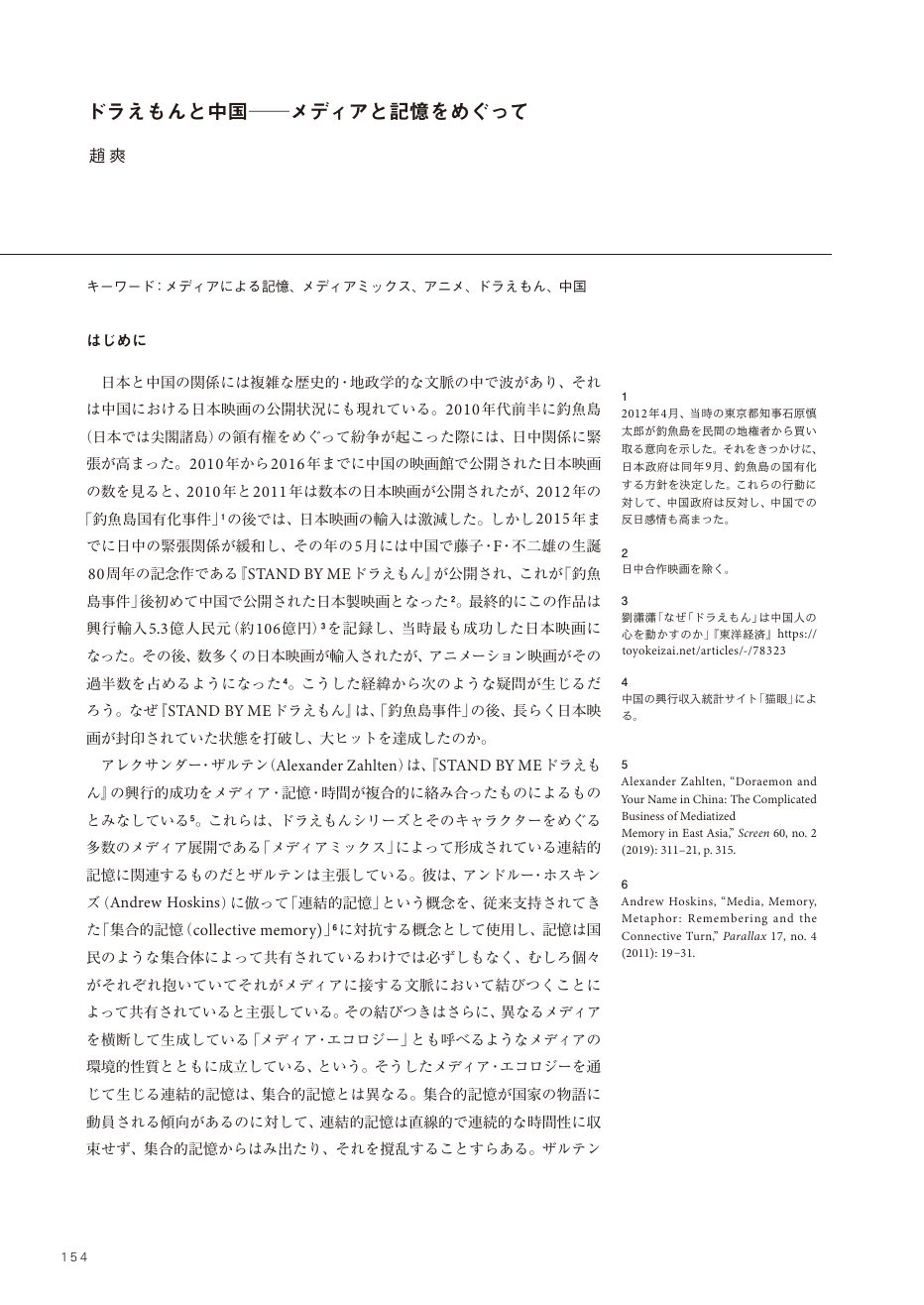
The article analysed, from the Japanese journal JunCture, concerns the reception of Doraemon in China. Its layout is simple and clear: a single column of text with notes in the margin. It poses no difficulty for a human reader or for the vision models, whereas the text models fail on it completely.
 1
2
3
1
2
3
ドラえもんと中国 — page 1
- Title. Clearly visible at the top of the page. The
pypdflibrary, used to extract text for the text models, did not return it at all: the page text begins with the number “154”. - A note citing an article in the journal Screen 60, no. 2 (2019). The models that did not receive the title took the cited article to be the document described: the journal Screen, the year 2019, the DOI of the cited work.
- The only information in the footer is the page number. The year of publication (2024) and the DOI do not appear anywhere in the PDF. The most frequent year in the text is 2015, taken from the bibliography.
The same beginning of the page as output by two text-extraction tools:
pdftotext / pdfminer
ドラえもんと中国─メディアと記憶をめぐって
趙爽
キーワード:メディアによる記憶、…
はじめに
日本と中国の関係には複雑な歴史的・地政学的な
文脈の中で波があり、それは中国における日本映画
の公開状況にも現れている。
pypdf (input to the text models)
154 ͡Ίʹ 日本ͱ中国ͷ関係ʹ複雑ͳ歴史的ɾ地政学的ͳ文脈ͷ中Ͱ 波͕͋Γɺ ͦΕ中国ʹ͓͚Δ日本映画ͷ公開状況ʹ 現Ε͍ͯΔɻ … ʰSTAND BY ME υϥ͑Μʱ ͕公開͞Εɺ
The kanji were preserved, but all of the hiragana and katakana were converted into characters from the Greek, Coptic and IPA blocks. “はじめに” (introduction) is rendered as U+0378 U+0361 U+038A U+02B9 (including a code point to which Unicode assigns no character), and “ドラえもん” as “υ ϥ ͑ Μ”: a Greek upsilon, a Coptic letter, a combining diacritical mark, and so on. The cause is the ToUnicode table of the embedded font, which maps the kana glyph identifiers to incorrect code points. Better extraction tools (pdfminer, poppler) handle this case differently and return correct text, whereas pypdf applies the mapping literally.
| model | input | title | year | journal | DOI |
|---|---|---|---|---|---|
| reference A / B | ドラえもんと中国 : メディアと記憶をめぐって | 2024 | JunCture / „Institutional Repositories DataBase” | — / 10.18999/juncture.15.154 | |
| gemini-3.1-flash | ドラえもんと中国─メディアと記憶をめぐって | 2023 | JunCture | 10.15083/0002000115 (fabricated; quotation: null) | |
| gpt-5.4 | ドラえもんと中国─メディアと記憶をめぐって | 2016 (from the bibliography) | Juncture | — | |
| claude-sonnet-4.6 | ドラえもんと中国——メディアと記憶をめぐって | — | JunCture | — | |
| deepseek-v3.2 | text | 日本Ξχϝͱ中国ͷ関係Λ検討͢Δ | 2019 | Screen | 10.1093/screen/hjz018 |
| qwen-3.5-max | text | υϥ͑ΜΛί͙Δ記憶ͱ日中関係 | 2019 | Screen | 10.1093/screen/hjz009 |
Several phenomena occur simultaneously in this example:
- DeepSeek took a sentence from the text as the title: “日本アニメと中国の関係を検討する” (“to examine the relationship between Japanese animation and China”), in the garbled form in which it had been received.
- Qwen composed from the garbled characters a plausible-sounding title (“memory surrounding Doraemon and Japanese–Chinese relations”) that the article does not contain.
- Both text models assigned to the article the DOI of the cited work and the journal from the note.
- Gemini Flash, despite reading the page correctly, generated a non-existent DOI in the format of a Japanese institutional repository (prefix 10.15083), with the “quotation” field set to
null. This is a typical hallucination, but one that can be detected automatically, since the model itself signals the absence of evidence. - Claude gave the correct title, but as the quotation for the journal field returned “JunCure 15 | 研究論文 | 趣 真”, reading the author's name 趙 爽 as 趣 真. The value is correct; the evidence is wrong.
- Reference B (OpenAlex) gives the name of a repository database as the “journal”. The reference standard, too, is therefore not free of errors.
6.2. Prevalence of corrupted text layers
All CJK documents were analysed to determine what proportion of the non-ASCII characters in the pypdf text falls into Unicode blocks in which Japanese text cannot occur:
Result: 20 of 80 Japanese PDFs (25%) have a corrupted text layer. These are mainly journals of Japanese medical and engineering societies, together with a few Chinese and Korean journals. In a control sample of German and Polish PDFs, the isolated detections concern mathematical articles containing genuine Greek letters.
Title and authors in Japanese PDFs: intact versus corrupted text layer
accuracy by model; the same 80 articles divided by μ(d)
ministral-8b (−10 pts). This is a post hoc analysis of 20 documents, so its result should be treated as strong evidence rather than as a definitive finding.Practical conclusion: part of the gap to the detriment of Japanese reflects not a weakness of the models in that language but the choice of text-extraction library. A CRIS pipeline that passes text to a model should first verify that the text is valid. The simple test \(\mu(d)\) suffices for this purpose; if the test fails, the page image should be used.
6.3. Effect of metric tokenisation on the scoring of Japanese titles
The second problem affecting Japanese lies neither in the PDFs nor in the models, but in the metric. The table shows sample titles that received a score of 0:
| reference (OpenAlex / publisher) | model answer (consistent with the PDF content) | difference |
|---|---|---|
| 重症患者の栄養療法における間接熱量測定 : 普及を目指した新世代間接熱量計の開発 | 重症患者の栄養療法における間接熱量測定:普及を目指した新世代間接熱量計の開発 | ASCII colon with spaces versus full-width colon |
| ドラえもんと中国 : メディアと記憶をめぐって | ドラえもんと中国─メディアと記憶をめぐって | colon versus dash (as printed) |
| 重症COVID-19肺炎患者の集約化とVV-ECMOによる治療経験 | 重症␣COVID-19␣肺炎患者の集約化と␣VV-ECMO␣による治療経験 | spaces around Latin-script insertions |
All three answers are correct. The source of the problem is the function \(T(\cdot)\) in the definition of the metric, which splits text on spaces. A Spanish title with one typographical error loses one token out of twenty. A Japanese title constitutes a single “token”, so a difference of one character yields a Jaccard index of 0 and no containment. A script-aware normalisation is sufficient:
(Unicode NFKC normalisation, followed by the retention of letters and digits only) for the results to change markedly:
Title accuracy: original versus normalised metric
8 LLMs, all languages; the same answers, a different comparison function
a–z, so that Japanese and Chinese surnames become empty strings and are always judged to match. After correction, author accuracy for Japanese falls from 0.80 to 0.70.Methodological conclusion
A metric designed with European languages in mind underestimates the score in one field and overestimates it in another, precisely for the languages under study. This difference exceeds the gap between the best and the weakest of the leading models. Cross-lingual comparisons without script-aware normalisation largely measure the properties of the metric's tokeniser.
6.4. Ambiguity of the publication year
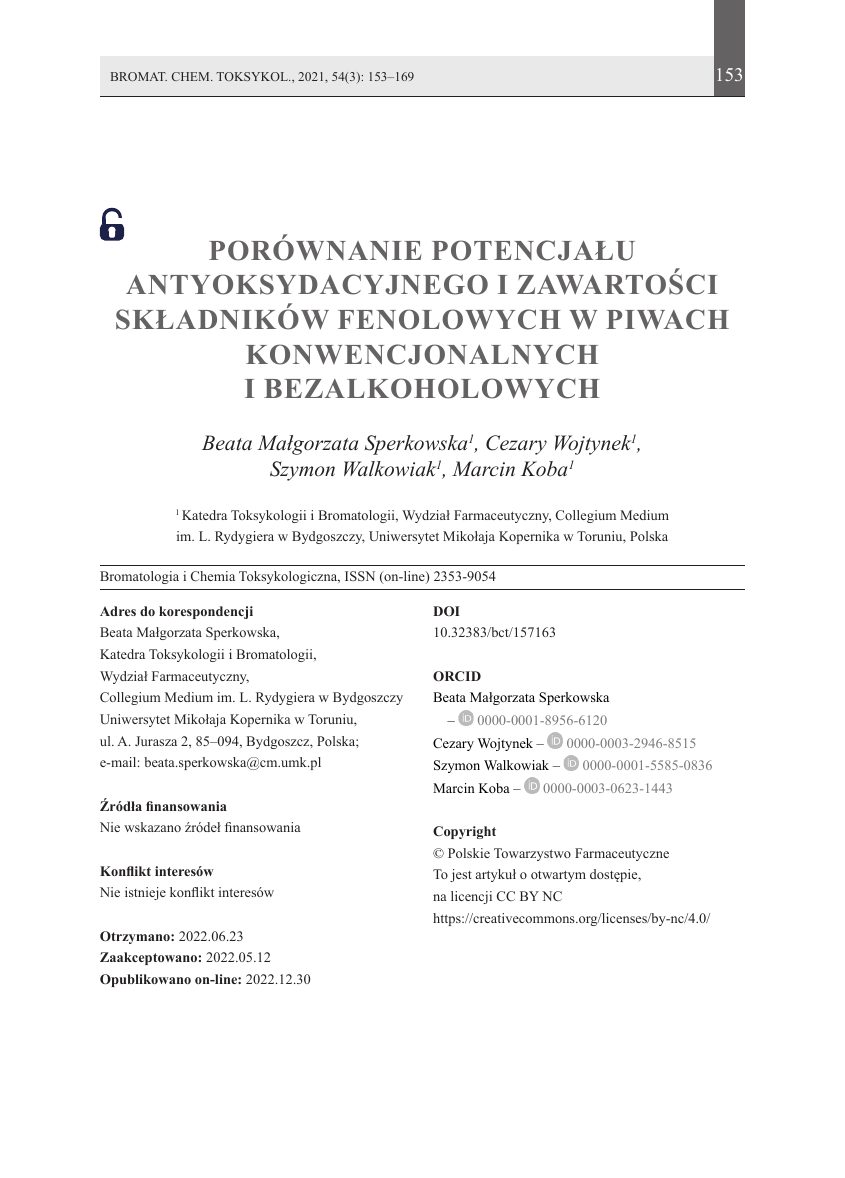
The next case concerns a Polish journal. For an article in Bromatologia i Chemia Toksykologiczna on polyphenols in non-alcoholic beers, all eight models unanimously gave the year of publication as 2021. All of them scored zero for this answer, because OpenAlex gives the year as 2023.
 1
2
3
4
1
2
3
4
Bromat. Chem. Toksykol. 54(3) — page 1
- Header: “2021, 54(3)”. Formally, this is the volume year. All models chose this value, and GPT, Ministral and Qwen quoted it verbatim as evidence.
- ISSN placed in a narrow strip between rules, above the metadata block. Only the ISSN of the electronic version is printed.
- DOI without the prefix “doi.org” and without a label, in the right-hand column under the heading “DOI”, next to the correspondence address.
- “Otrzymano: 2022.06.23, Zaakceptowano: 2022.05.12” (received; accepted). According to these data, the article was accepted six weeks before it was received. Online publication took place on 30.12.2022. The only model that took this block into account (Claude) gave the year 2022.
Dates associated with a single article and the “year of publication”
all dates relating to a single article
This is not an isolated case. Polish journals catching up on publication backlogs regularly issue, in year N+1 or N+2, a volume dated to year N. Teka Komisji Urbanistyki i Architektury of the Polish Academy of Sciences carries “TOM XLIX/2021” in its header, while OpenAlex gives the year 2023. Nowa Audiofonologia prints “2024; 13(4)” and “Opublikowano: 30.12.2024” (published), while the registry gives the year 2025. In each of these cases all models agree with one another, are correct with respect to the PDF and are incorrect with respect to the registry. For a CRIS and for parametric evaluation, in which the year determines the reporting period to which a publication is assigned, this discrepancy is of considerable importance.
6.5. Title selection in bilingual publications
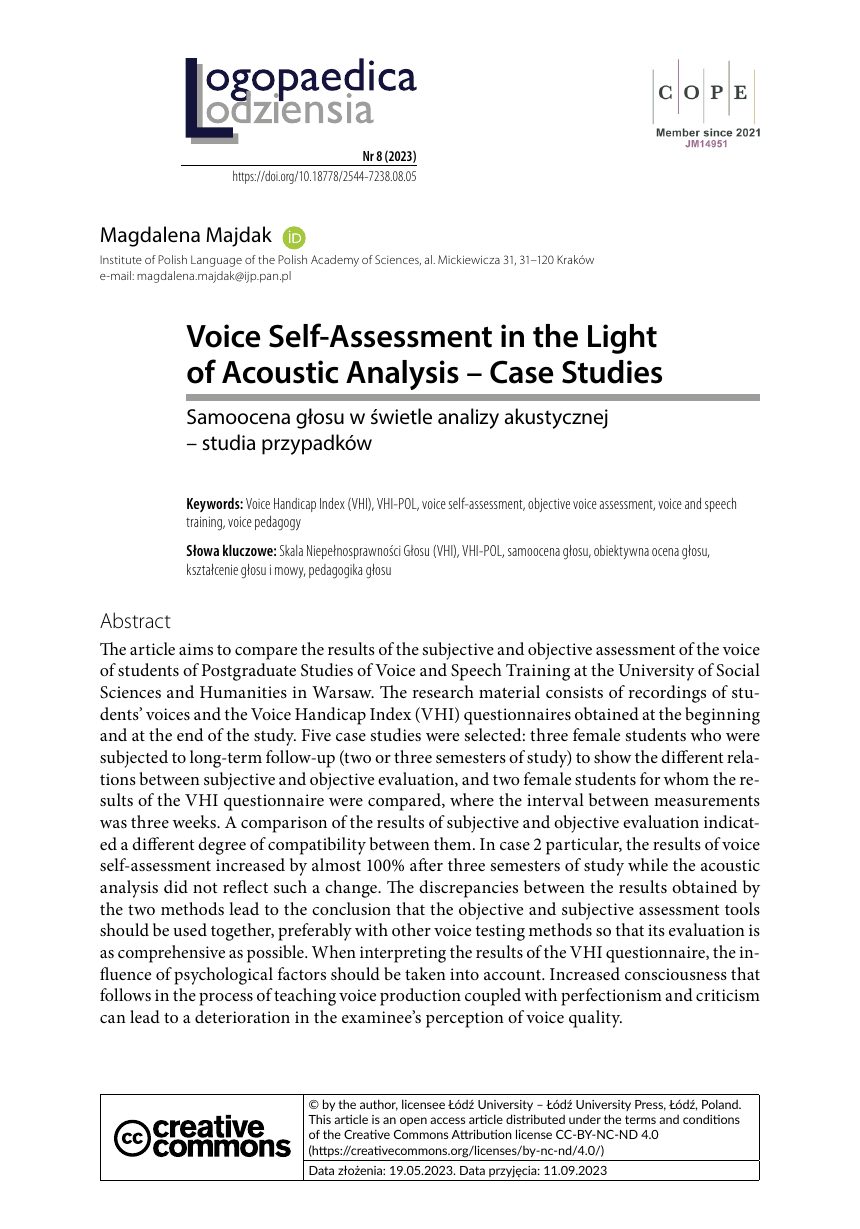
A second problem concerning Polish journals is bilingualism, as illustrated by the two articles below.
 1
2
3
4
1
2
3
4
Logopaedica Lodziensia no. 8 (2023)
- “Nr 8 (2023)”: the year in parentheses next to the issue number, in small type.
- English title, large and bold, displayed as the main title. All models chose this one.
- Polish title, smaller, in the form of a subtitle. This title appears in the registry and on the publisher's web page. Result: zero for all models.
- Submission and acceptance dates in the licence footer at the bottom of the page.
 1
2
3
4
1
2
3
4
Ruch Prawniczy, Ekonomiczny i Socjologiczny 84(4)
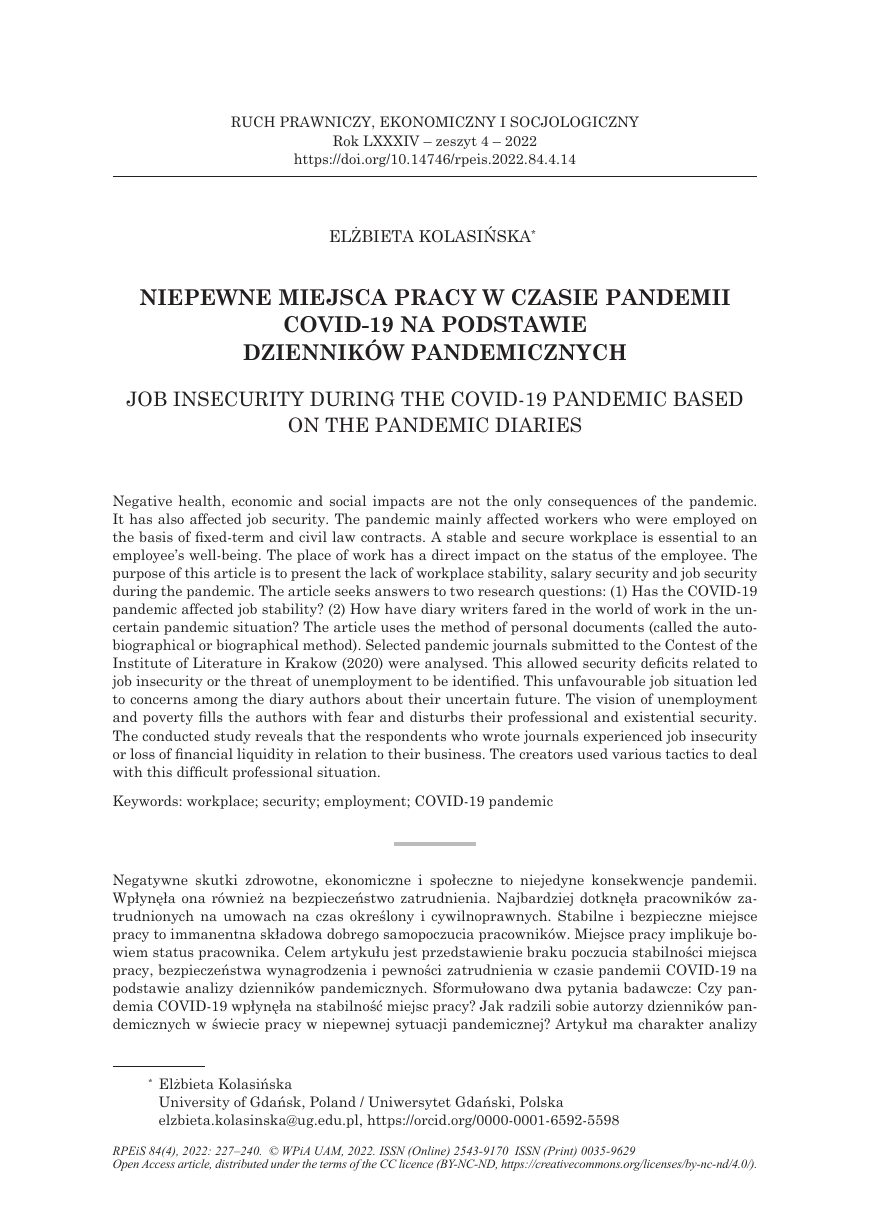
- Year, issue and DOI in the header, centred and legible. The models made no errors here.
- Printed title: “NIEPEWNE MIEJSCA PRACY…” (insecure workplaces). The registry and the publisher's web page give “Niepewność miejsca pracy…” (job insecurity). The title in the registry differs from the title in the article.
- English title “Job insecurity…”, which corresponds more closely to the registry version.
- Online and print ISSNs in a footer set in very small type at the bottom of the page, together with copyright and licence information. This is an example of an atypical placement of metadata.
In the first case, the models choose the visually prominent title, whereas the registry holds the title in the language of publication. In the second, the models faithfully transcribe the content of the page, and the reference differs from the printed version by one word. The reverse situation also occurs: in Psychiatria Polska the PDF contains the Polish title “Stres wojny…”, while the registry holds the English “The stress of war…”. For a CRIS, the correct answer is both titles with a language tag, which a schema with a single title field does not provide for.
Common cause
In none of the four cases described does the model hallucinate in the strict sense. The failure lies in the components surrounding the model: the text-extraction library, the metric, the reference or a schema that assumes a single title and a single year. At the screening stage, about 26–34% of each model's cells fall into the category “inconsistent with reference”; without manual annotation it is not yet possible to determine how many of them are cases of this kind.
7. Error taxonomy
Cell-level taxonomy of outcomes
share of cells (document × field) in each class
The analysis yields three observations:
- Schema compliance has been resolved. Output structure is no longer a limiting factor. JSON is valid in 99.5% of cases, and the remainder consists mainly of empty API responses and the disordered output of the smallest model.
- Provenance error (1–4%) is more significant than hallucination: the value is correct, but the quotation indicating its source is wrong or missing (as with “趣 真” in Claude's answer). If downstream processing relies on the
evidence_spanfield, this error is more serious than it appears. - Normalisation errors (4–8% for the Gemini models, about 0% for Claude and GPT) are values that are semantically correct but not in canonical form: letter case in the DOI, a missing hyphen in the ISSN, a year followed by a full stop.
8. Implications for CRIS systems
- Registry before model. Spending USD 250 on tokens to obtain a worse result than a free API provides is an inappropriate default choice.
- A low-cost model is sufficient. In a schema-constrained task, the use of the most expensive models is not justified.
- Verification of text before it is passed to the model. A simple test for garbled characters prevents the loss of 80% of accuracy on one in four Japanese PDFs. The alternative is to pass the page image directly to the model.
- The ability to decline is an advantage. A model that leaves the ISSN field empty when the value is absent from the document performs better than one that always enters some value.
- A CRIS schema should accommodate multilingualism and multiple dates. Single
titleandyearfields do not reflect the practice of Polish and Japanese journals. - Cross-lingual metrics require script-aware normalisation. Otherwise, what is being compared is tokenisers rather than models.
9. Limitations and further work
The results presented come from the screening stage. References A and B are operational sources, not absolute truth; the cases from Bromatologia and RPEiS show that they, too, contain errors. Definitive values (true accuracy, the true hallucination rate and the division of the 26–34% of “inconsistencies” into model errors and reference errors) will be provided only by the gold set of 96 articles, annotated manually by two people with adjudication of disagreements. The set has been selected according to a rule registered before the results were examined and is awaiting annotation.
The analysis of the corrupted text layer (Fig. 8) and the recalculation of title accuracy after normalisation (Fig. 9) are post hoc analyses, carried out after the results had been examined. They were not part of the plan registered before the study and should be interpreted with this caveat.
The entire screening study (9 models × 960 documents) cost about USD 252 in API fees. All analyses presented in this post consist solely of reprocessing existing results and incurred no additional cost (USD 0).
Methodology in brief. Corpus: 960 OA articles from OpenAlex, stratified as 4 years × 12 languages × 4 fields × 5, sampled with a fixed seed. Schema: 11 fields with provenance (source type, quotation, confidence, normalisation). Prompt: a single canonical prompt (V1), temperature 0. Input: dynamic page trimming per document. Vision models receive the PDF; text models receive text extracted with pypdf. GROBID 0.9.0 run locally (header endpoint, without Crossref consolidation), Docling 2.93. Evaluation: max(A, B) conditional on availability; results for A and B reported separately. The results are robust to the exclusion of flagged records (Δ ≤ 0.004).
The results will be presented at the EuroCRIS 2026 conference.